
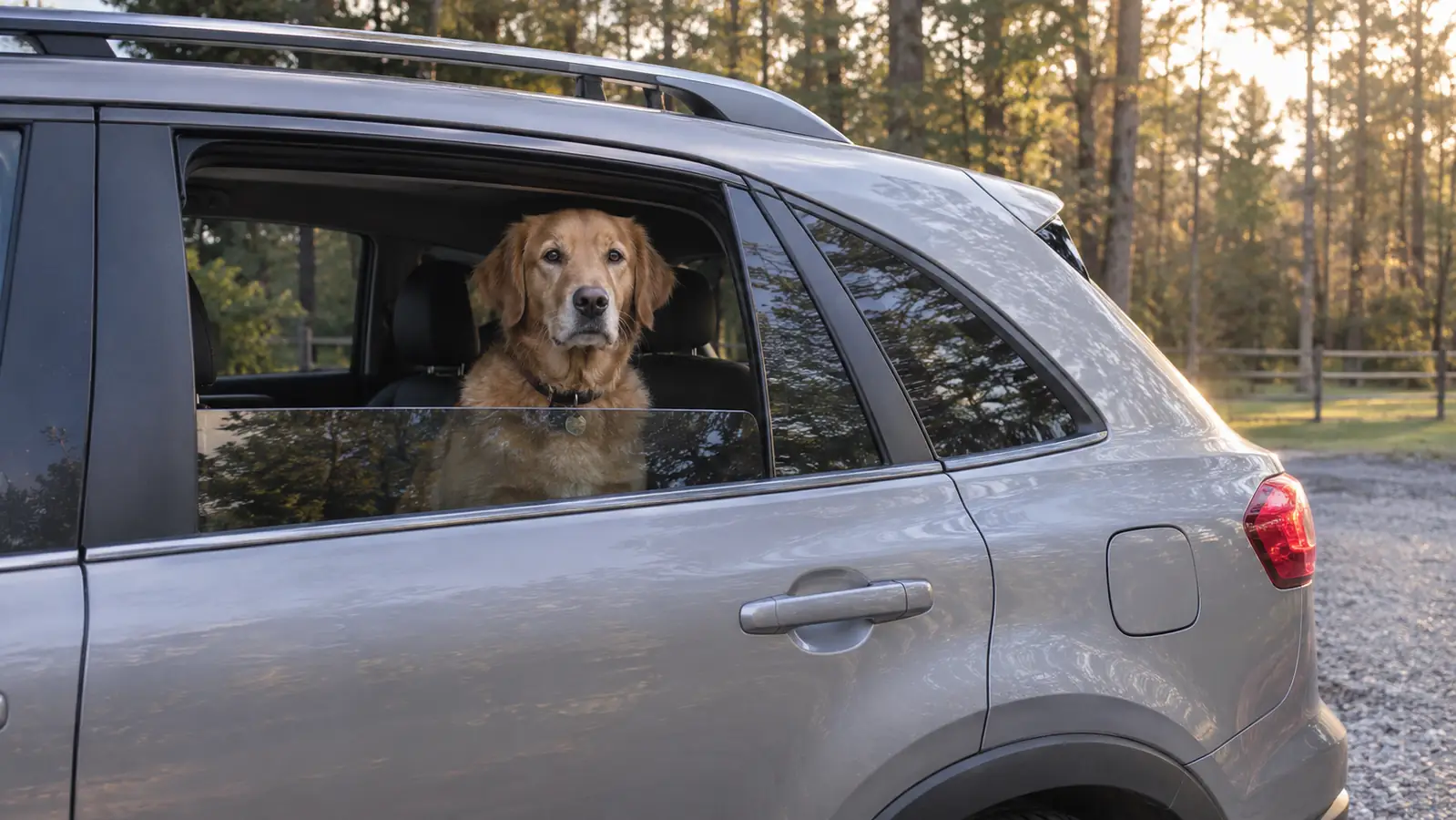
A clip-in seat belt tether is a short strap with a clip at each end. One end clicks into the seat belt buckle. The other end snaps onto whatever harness the dog is already wearing. It costs very little, it lives in a door pocket, and it goes on in about four seconds. That is why so many people buy one the night before a trip and call the job done.
Here is the short answer. The tether is the cheap half of the system and the harness is the half that does the work. If your dog already wears a harness you trust, and the only thing you are trying to fix is a dog who climbs over the console on the highway, a tether fixes that today. If you want the straps to land in the same place on the dog every single time, and you want the pull spread across his chest instead of wherever the clip happens to sit, you need a harness built for the job. The Kurgo Tru-Fit is the one I bought for my three dogs in May 2024, and the 10-inch tether that came in each box is the same kind of strap you can buy on its own.
| Kurgo Tru-Fit Harness | Clip-In Seat Belt Tether | |
|---|---|---|
| What comes in the box | The harness plus a 10-inch seat belt tether with a steel carabiner | The tether only. You supply the harness |
| Cost | More, because the harness is part of it | Very little, and it may be all you need to fix the front-seat problem |
| Crash claim | The listing calls it crash test-certified. That is the listing's word, not my testing | Sold as a restraint strap. No harness rating travels with it |
| Fit and adjustment | Five points of adjustment and a padded chest plate, about 20 minutes per dog the first time | No adjustment at all. If the harness fits badly, the tether does not help |
| Works with gear you already own | Only as a set. The harness is the system | Clips onto any harness you already have |
| Time to put on | One buckle, but the first fitting is the slow part | About four seconds |
| In a sudden stop | Pull spreads across the chest plate and shoulders, where the straps were set to land | Pull lands wherever the clip sits on the harness, which you did not choose with this in mind |
| Washing | Hand wash only, per the listing, and recheck the fit afterward | Wipe it or hose it. Nothing to wash |
| Warranty | Lifetime warranty. I have never had to use it | Varies by maker, usually a season at best |
| Storage | Bulky enough that three of them fill a bag | Fits in a door pocket |
Both pieces work the same way at the buckle. The metal tongue goes into the receiver with a click, the same click your own belt makes, and you tug it once to be sure. The difference is at the other end. On my dogs, the tether's steel carabiner clips to the harness and the strap is about a forearm long, so a dog can stand, turn around and lie down, but cannot reach the front seat. That is one job, and it is worth doing. It is not the same job as deciding how the dog's weight is carried when the strap goes tight.
Our first trip with all three set up was Door County in September 2024, and the first stop taught me the routine. I park, I shut the engine off, and then I go around the car door by door instead of reaching across three dogs at once. Murphy comes out first because he is the one who will step on a strap, then Dot, then Biscuit, who has learned that the sound of a buckle means grass is coming. Getting everybody out takes a few minutes. Getting everybody back in and clicked takes about the same, and I have stopped pretending otherwise when I plan a stop.
The word in the title is safer, and I want to be careful with it. I am not going to tell you that one of these is safer than the other, because I have no way to know that and neither does a blog post written at a kitchen table in Iowa. What I can tell you is that the two pieces do different jobs. The tether is the anchor. The harness is what the anchor pulls against. A good anchor on a harness that fits badly is still a bad setup, and a good harness with no anchor at all leaves the dog free to move around the car while you drive.
Where Kurgo Tru-Fit Wins
The first advantage is that the harness and the tether were sold as a pair, in one box, with one claim attached to the pair. The listing says the harness is crash test-certified. I want to be plain about what that means coming from me, which is that the listing says so. I have never watched a crash test, I have never run one, and I am not a safety tester. What I can tell you is that a strap by itself does not come with a claim like that, because a strap cannot decide where the force lands. It pulls on whatever it was clipped to, and the harness underneath is doing the rest of the work.
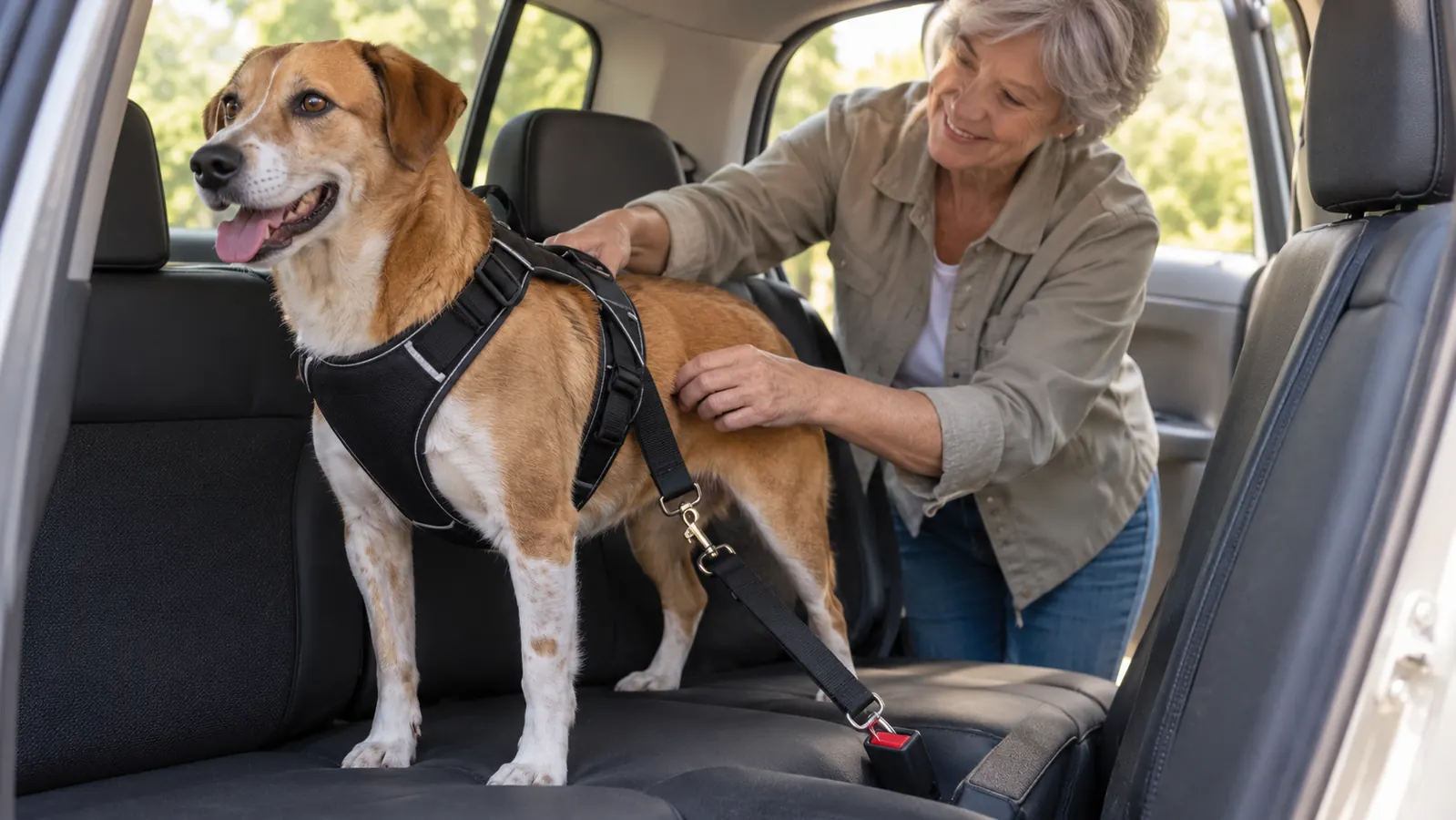
The second advantage is fit, and it is the one I did not appreciate until all three dogs were set up. The Medium has five points of adjustment and a padded chest plate. Setting those five points took about twenty minutes per dog the first time, and Biscuit's took a second try because I had the chest strap too loose and could see daylight under it. Once a harness is set, it goes on the same way every time, which is worth more than it sounds. A tether has no opinion about how a harness sits. A harness that has ridden up around the dog's ribs stays ridden up, strap or no strap.
The third advantage is that these are not car-only pieces of gear. My three wear theirs out of the car at rest stops, so the dog is already dressed when we get back in and nobody is wrestling a harness in a parking lot. They are hand wash only according to the listing, so I do them about twice a year in the sink, and I check every adjustment afterward, because a wash or a few pounds either way will change the fit. Nothing has broken in two years. The harness also carries a lifetime warranty, which I have never had occasion to use.
I have also learned to check the fit on a schedule instead of waiting until something looks wrong. After the sink wash in the fall, and again in the spring when the dogs blow coat and their weight shifts, I put each harness on and slide two fingers under the chest strap. If a whole hand goes under, it is loose and I take it in. If two fingers will not fit, it is pressing and I let it out. That is not a scientific method and I would not call it one. It is the check my hands know, and it has kept all three harnesses on the same setting since the first week.
A tether decides whether the dog can reach the front seat. A harness decides where the pull lands. Only one of those is a fit question, and the fit is the part you can control before you drive.
Where a Clip-In Seat Belt Tether Wins
The tether wins on money and on fuss, and it is not close. One clip, one click, done. There is nothing to adjust, so nothing drifts out of adjustment, and there is nothing to hand wash. It goes in a bag when someone else is driving, and the front-seat problem is solved for very little. For a small dog on short trips around Decorah, that may be the whole of what the trip needs.
It also wins on compatibility. The tether does not care what the dog is wearing. If you already own a harness you like for walks, the tether turns it into car gear this afternoon, with no fitting session and no twenty minutes on the kitchen floor. That flexibility is real. It is the reason I would not tell anyone to throw a tether away, and the reason I keep one in the door pocket even though all three dogs have their own by now.
What a tether cannot do is stay out of the way. It is a fixed strap with a clip at each end, and on a dog who turns in circles before she lies down, that strap finds a leg sooner or later. Dot does this. On the drive to the Black Hills in July 2025 I pulled over twice in the first hour to unwrap it from behind her front leg, and after that I started hooking her up while she was still standing still, with my hand on her chest, because she cannot wind herself into it if she has not started turning yet. You find these things out on the road and you adjust for them. It is not a fault in the strap.
Here is the honest limit. A tether does not turn a plain walking harness into something rated for a car, because no strap can do that. It does nothing about a dog that backs out of a collar, which is why I never clip anything to a collar in a moving vehicle. And at a rest stop, one clip and the dog is loose, which is either the best thing about a tether or the worst thing, depending on whether the dog has learned to wait for you.
One practical note that comes up whenever I describe this to someone. Each tether takes a seat belt receiver, so with three dogs I am using all three in the second row of the Highlander. That is why a stop looks like a small rigging job, and why the buckle count, not the strap count, is the thing I actually notice at a gas station.
The Harness Is the Half With the Claim On It
Three Mediums, three dogs, one 10-inch tether in each box. The five adjustment points took about twenty minutes per dog and I have not touched them since.
Amazon Check Today's Price on Amazon →
Who Should Buy Which
Buy the harness if the dog rides more than a few times a year, if he is over about thirty pounds, or if you want one piece of gear that works in the car and again at the rest stop. Buy it especially if you have a dog like Dot who paces and settles faster when the routine is identical every time. My three are all size Medium and all inside the listing's 75 pound limit, and they weigh 30, 38 and 46 pounds, which is a wide spread for one size. That is my three dogs. It is not a claim that Medium suits every dog.
Buy only the tether if you already own a harness you trust, if the dog is small, or if the only thing you are trying to fix is a dog who climbs into the front seat. Buy both if you are like me and would rather the dog be dressed before the engine starts. What I would not do is buy the tether and assume the job is finished. It is half the job. It is the half that costs the least, and it is the half that does not care whether the other half fits.
One more thing applies to either choice. My three ride on the second row of the Highlander under a hammock cover. The dogs stay buckled with the cover in place, and I am not going to describe the routing through it because I have never taken that part apart to look. The point is that the cover sits on the seat, not on the dog, so whichever restraint you pick is still the thing doing the work.
The Mistake I Made First
The dogs we had before rode loose on an old bedsheet across the back seat, and for years that felt normal. The trips were short, nothing happened, and I told myself that was the same as being careful. Then in May 2024 Murphy climbed into the front seat on the highway while I was driving, and I found out how fast that happens when you cannot do anything about it. We had never had a crash. We had never had a hard stop that hurt anyone. We had simply been lucky in a way I stopped being comfortable with.
What the first week actually looked like matters more than what I bought. I fitted all three harnesses at the kitchen table on a Tuesday, one dog at a time, and then we did short drives into Decorah and back, four days running, maybe twenty minutes each. Biscuit whined for the first two. Murphy lay down by the third day. Dot took close to a week, and what settled her was the order of things rather than the harness itself: same door, same seat, same click, every time. By the Door County trip in September they were walking out to the car on their own instead of needing to be coaxed across the driveway.
If I were starting over, I would buy the harnesses first and let the tethers come with them, in that order. The tether is the part that stops the climbing. The harness is the part that was built to be pulled on. Buying them together means you are not guessing about which harness the tether was meant for, and you are not discovering in a parking lot that the clip does not sit well on the harness the dog already has.
One Box, One Tether, and the Dog Is Already Dressed at the Rest Stop
Three of the Kurgo Tru-Fit in Medium, bought in May 2024, still going, still hand washed twice a year. The 10-inch seat belt tether comes in the box, which is the arrangement I would pick again.
Amazon See the Current Price on Amazon →