
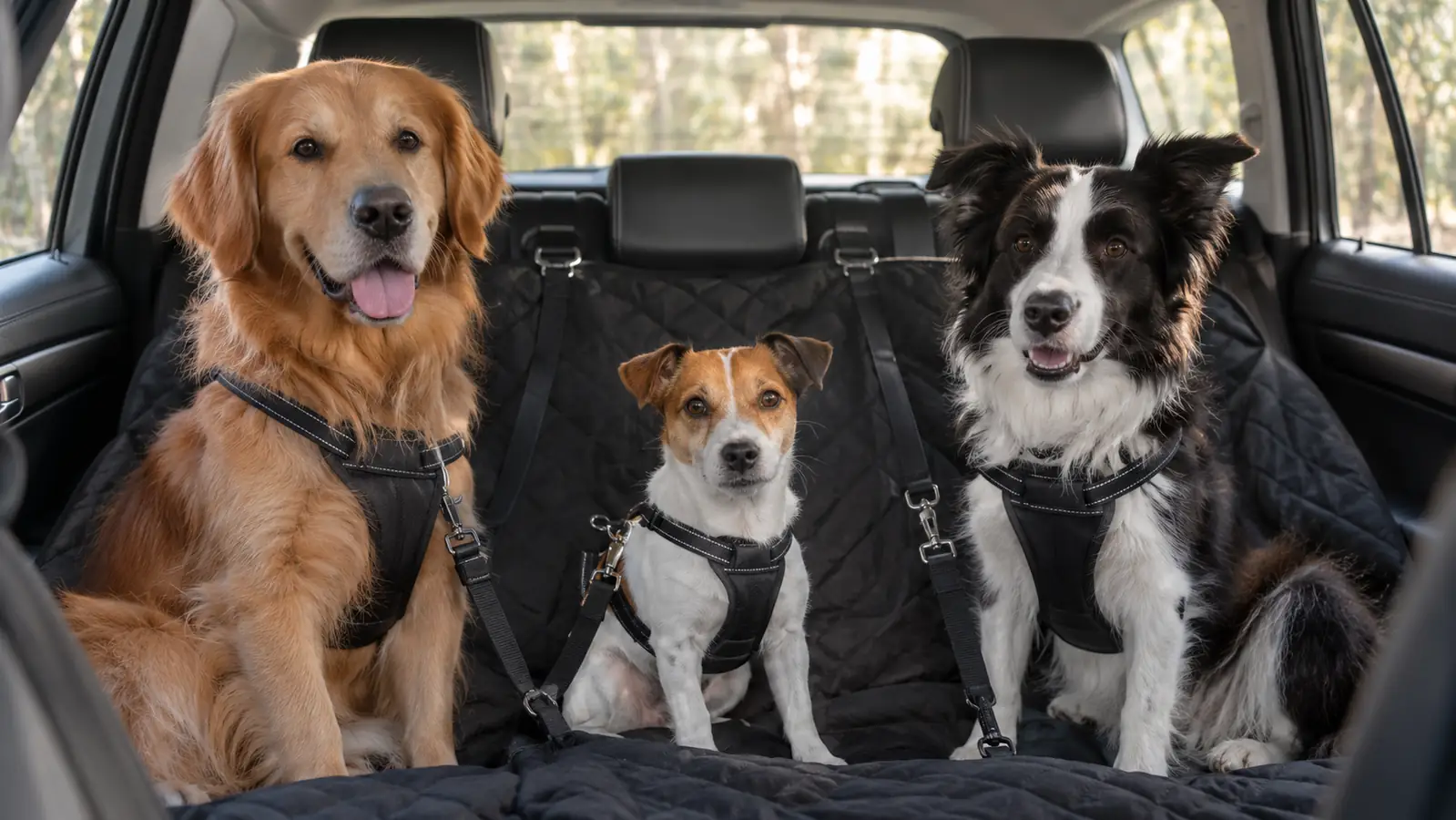
Three dogs in one back seat is not a seating problem. It is a counting problem, and I counted wrong for years. Biscuit, Dot and Murphy ride in the second row of a silver 2019 Toyota Highlander. For a long time they rode loose on an old bedsheet. The trips were short, and I told myself that made it fine. Then Murphy climbed over the console into the front seat on the highway, and the bedsheet era ended that afternoon.
What follows is how I keep three dogs buckled in now. It is not a safety manual and I am not a trainer. I ran a hardware store in Decorah, Iowa for 29 years, so what I know how to do is read a package, read a return policy, and count things. What I can tell you is the order I do this in, and what it takes at every stop. The short version: each dog has its own Kurgo Tru-Fit Smart Harness, size Medium, and each harness has its own 10-inch seatbelt tether. Three harnesses, three tethers, three seat belts. We bought all three in May 2024 and they have ridden in the car ever since.
Three harnesses, three tethers, three seat belts. Start by getting the first one fitted right.
The Kurgo Tru-Fit Smart Harness is the piece the rest of this depends on. Size Medium, five points of adjustment, a padded chest plate, and a 10-inch seatbelt tether in the box so you are not hunting for parts at the last minute.
Amazon Check Today's Price on Amazon →Step 1: Count the seat belts before you count the dogs
The second row of the Highlander has three seating positions and three seat belts. That is the number that matters. Not the number of dogs you own, and not the number who fit back there if everyone squeezes. Ours is a 2019 we bought used. When we were shopping, I counted the belts in the back before I counted the cup holders, and I would do that again.
Three dogs and three belts, and you are in good shape. Four dogs and three belts, and you should say it out loud: one dog is not riding buckled. I would rather tell you that plainly than sell you a fourth harness and let you pretend. Two dogs on one tether is not a plan either. Unclip one at a rest stop, turn your back to deal with the other, and you are back to loose dogs before you reach the next exit.
I have heard every version of the workaround. One dog on a lap. A dog loose in the cargo area with the seats folded down. A dog wedged on the floor behind the console. None of those are seat belts. If you are short a belt, the honest answer is to leave a dog home or make two trips, and I know that is not the answer anybody wants.
Count the tethers while you are at it. The Kurgo harness ships with one 10-inch seatbelt tether, so three harnesses gave me three. If you buy them one at a time, check the box. A harness without a tether is a walking harness and nothing more.
Step 2: Fit every harness before the engine turns over
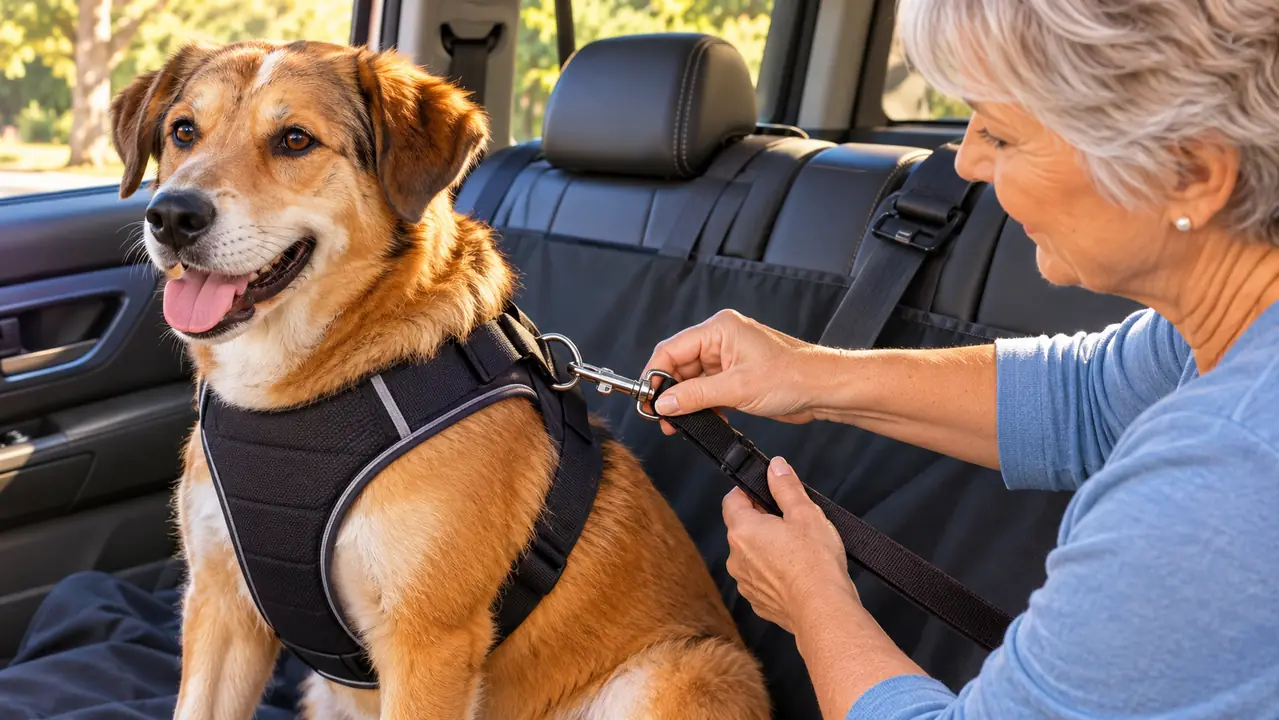
Do the fitting in the driveway, not in a parking lot. The first harness took me about 20 minutes, and that was with reading the tag twice. There are five points of adjustment and a padded chest plate, and each dog needed a different combination.
Biscuit is 30 pounds and she took a second try. Dot is 38 and Murphy is 46, and both of them settled on the first pass. All three wear a Medium. The listing puts the Medium at up to 75 pounds, but that is a ceiling and not a rule, and I will not tell you a Medium fits every dog. Fit is what the straps do on the dog standing in front of you. Two fingers should slide under a strap without you hauling on it, and the chest plate should sit flat instead of riding up toward the throat.
One more thing about fit. That padded chest plate is what keeps the straps from digging in when a dog leans against the tether. If you leave the harness loose to be kind, the padding slides off to one side and the strap does the work instead. That was my mistake with Biscuit the first time, and it is why she needed a second try.
Then check them again after the first short drive, and again after every wash. The tag says hand wash only, so that is what I do, about twice a year, and every strap gets rechecked while they dry. A harness that has been washed and not re-fitted is a harness that is too loose.
Give it a week. Ours took about that long on short drives around the county before the standing and the sighing stopped. Nobody has tried to back out of one since. Dot was the last to quit sulking, which is Dot.
Step 3: Clip the tether to the seat belt, not to the seat
The carabiner end goes on the harness. The other end clicks into the seat belt receptacle the same way a passenger belt does. That is the whole assembly, and after a few trips it takes about fifteen seconds a dog.
The tether is not there to pin the dog down. It is there to keep the dog out of the front seat and out of the footwell. Ten inches leaves room to sit up, turn around and lie down, and not enough room to climb the console into your lap. Murphy taught me that one.
One thing I will say plainly, because I have read the listing more than once. The harness is described as crash tested. That line comes from Kurgo and I have never tested it myself. I am not going to tell you what happens in a crash, because I do not know. What I can tell you is that a dog who cannot reach the front seat is a better passenger than one who can, and that much I can verify from the driver's seat.
Check the carabiner at every stop. Not because anything has broken, because nothing has, but because a clip that is not fully closed looks a lot like one that is when a dog is leaning on it. The harness carries a lifetime warranty. I have never used it.
Three harnesses, three tethers, three seat belts. If those numbers do not match, you do not have a plan yet, you have a car full of dogs.
Step 4: Give every dog a seat and leave it alone
Biscuit rides behind the driver. Dot rides in the middle. Murphy rides behind the passenger seat. That order was not picked for comfort. It was picked because Biscuit will steal food out of any bag within reach, Dot paces when she does not know what is expected of her, and Murphy is damp and shedding about eleven months out of twelve.
Keeping the order fixed did something I did not expect. After about a week, all three quit arguing about it. Now Dot steps into the middle without being lifted, which is worth more than any treat I have tried. A dog who knows where she is going gets in faster, and a dog who gets in faster is a dog you are not standing in a parking lot waiting on.
It also makes the stop routine shorter, because every dog knows exactly where they are going back to. Anything that cuts minutes off a stop with three dogs on leashes is worth keeping.
Step 5: Build a stop every two hours and run it the same way
We stop about every two hours. Not because the dogs demand it, but because I do, and because a fixed routine means nobody sits clipped in while I am distracted by something else. Two hours is not a rule out of a book. It came out of a full tank, a full bladder, and three dogs who start having opinions around the ninety minute mark.
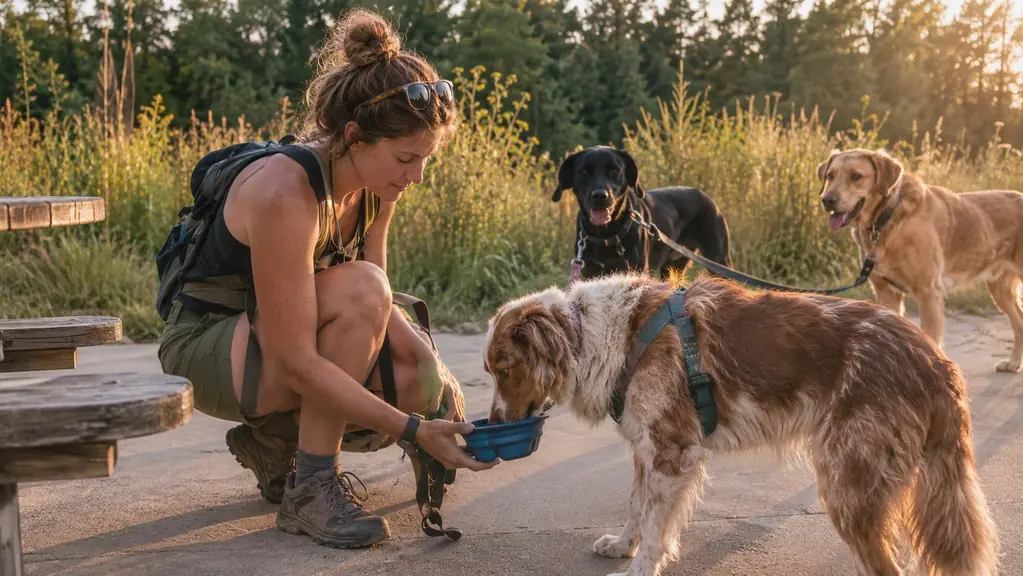
Water first, one dog at a time. Murphy drinks first and is done fast, so he gets a refill. Then Dot. Then Biscuit. The bottle I carry has a fold cap that turns into the bowl, so no separate bowl rolls around under the seat, and the push button lock has not leaked in the car yet. Eighteen ounces does not cover three dogs on a warm day, so there is also a plain gallon jug of tap water from home in the back. The bottle gets hand washed at the motel.
Then a walk. All three walk on their harnesses at rest stops, which is why the harness has to be something a dog can walk in and not a car-only device. One piece of gear that does both jobs is one thing to check instead of two, and it is one less thing to forget on the kitchen counter.
Then back in, in the same order, and I walk the row and check three buckles. That takes a few minutes at every stop. It is the part I complain about. It is also the part I would not skip.
At the motel, the dogs come out one at a time on leash and go into the room before the luggage does. That is not sentiment. It is so nobody is standing in a parking lot with three dogs and a suitcase.
What Else Helps
A hammock style cover across the second row does more than keep the seat clean. Mine went in a month after the harnesses and it hangs from the headrests. It stays in the car all year. The dogs stay buckled with it in place. The middle sags a little with three of them on it, and nobody can sit back there without taking it down, but Gene rides up front, so it only comes down for washing.
Two travel beds ride in the cargo area and come out first in a motel room. Murphy takes one and Dot and Biscuit share the other. Setting them down in the same corner before anything else comes through the door is what settles Dot. It took two or three nights the first trip. By the second trip she was down on the first night. They are thin, and they are not a replacement for the beds at home. In June they go on the tent floor at Backbone State Park, and that is the one time I am glad they are thin.
The water bottle clips on with a carabiner for walks, and the spare rides in the door pocket so I am not digging for it at a stop. Before any of this, we used a margarine tub and a jug, and the jug slopped on the floor every time I braked.
There is a first aid kit under the driver's seat now. Dr. Lindqvist asked me once what I carried in the car and I did not have a good answer, so I fixed that. A kit is not a substitute for a vet. Mine has handled a tick and one cut pad. If something is actually wrong, you call the vet. I am not going to walk you through a dose or a treatment, and I would be careful of anyone who does.
The order we bought things in was not planned either. Harnesses in May, the seat cover in June, the beds in August, the first aid kit in March, the water bottles in April. Each one showed up because something went wrong without it. That is usually how gear gets bought, and it is a better way to buy it than a list from somebody who has never had three dogs in one row.
None of this is complicated. Three harnesses fitted properly, three tethers on three seat belts, the same three seats every trip, and a stop every two hours that runs the same way each time. The first week is fiddly. After that it is just what we do, and the September drive to Door County has gotten a lot quieter than it used to be.
Fit it in the driveway this week, and the next long drive gets a lot simpler
Five points of adjustment, a padded chest plate, a 10-inch tether with a steel carabiner, hand wash only, lifetime warranty. Check the fit before the first drive, and check it again after every wash.
Amazon Check Today's Price on Amazon →